Free · PDF template
Memory Care Activity Calendar: a Free Template and a Sample Month
A printable memory care activity calendar template, a filled-in sample week you can copy tomorrow, and twelve months of ideas — planned by ability level, so one calendar serves the whole unit instead of three programs running side by side.
A sample memory care calendar: one week, filled in
Most calendar pages online are one community's schedule for one month, which tells you what they did in March and nothing about how to plan yours. Here is a week built from the template instead. Every slot carries an ability code so staff can see at a glance who it serves: I for Independent, S for Supported, Sen for Sensory.
| Day | Morning · 10:00 | Afternoon · 2:00 | Evening · 6:30 |
|---|---|---|---|
| Monday | Trivia hour: the 1960s music roundI · S · Sen | Balloon volleyball, seated circleI · S | Old radio shows, lights lowSen |
| Tuesday | Hands busy: folding warm laundry, sorting buttonsS · Sen | Watercolor at the big tableI · S · Sen | Hand massage with lotionSen |
| Wednesday | Music & movement: singalong with rhythm instrumentsI · S · Sen | No-bake cookies (the smell does the work)S | A classic film clip and popcornSen |
| Thursday | Memory lane: one photo per personS · Sen | Conversation cards over coffeeI · S | Hymns and familiar songs, quietlySen |
| Friday | Social games: large-print word search or bingoI · S | Manicures and hand careS · Sen | Happy hour: mocktails and 1950s hitsI · S · Sen |
| Saturday | Coffee cart and sensory bin on the unitSen | Family visit hour: conversation cards on every tableI · S · Sen | Soft music, warm drinks, early quietSen |
| Sunday | Worship service or hymn hourI · S · Sen | Window hour: weather, birds, the streetSen | Reading aloud: poems and old lettersS · Sen |
Read it down a column and you see the shape of a memory care day: the demanding things sit in the morning while attention is freshest, afternoons soften into hands and music and talk, evenings repeat and stay calm. Read it across a row and you see the weekly anchors, the same five themes in the same five slots every week. Residents stop needing to be told what comes next, and staff stop planning from a blank page.
One line that never appears on the grid and matters more than most of it: a ten-minute one-to-one visit for every resident who does not leave their room, every day, logged. Surveyors look for those visits. Residents feel them.
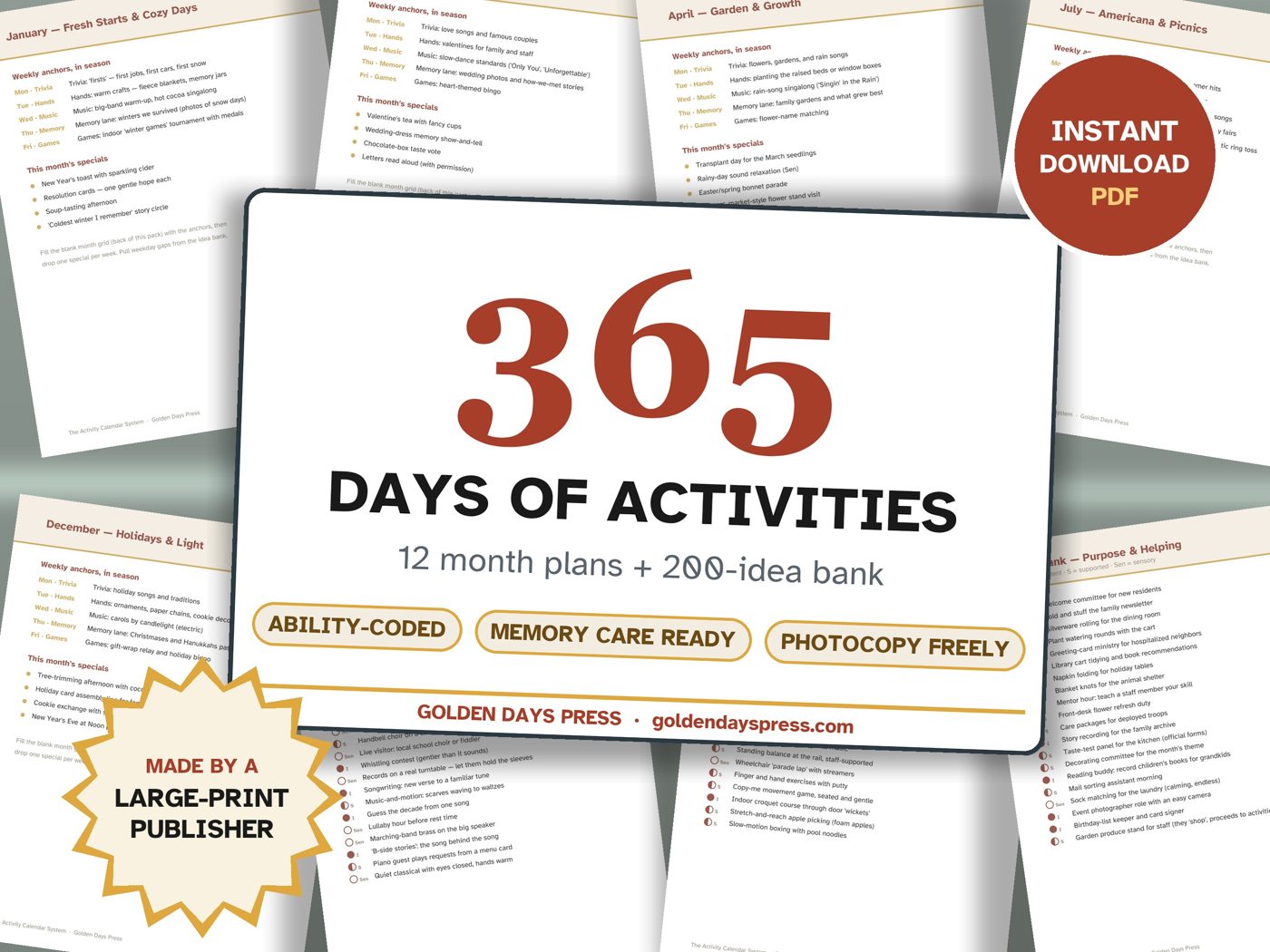
That's one week of one month. The full system has all twelve planned, 200 ideas coded by ability, and the bad-day plan. Activity Calendar System, $12.99 ↓
How the template plans the month for you
Five weekly anchors
Pick the theme for each weekday once, and the month fills itself. The template ships with these five; swap any that don't fit your residents.
- Monday — Trivia hour. Decade trivia read aloud, stories welcome. Start with our free 50-question set.
- Tuesday — Hands busy. Sorting, folding, simple crafts. Real work, warm from the dryer, impossible to fail.
- Wednesday — Music & movement. Songs from residents' young years, seated movement, rhythm instruments.
- Thursday — Memory lane. Photo prompts and conversation starters that ask "tell me about," never "do you remember."
- Friday — Social games. Large-print word searches, bingo, gentle competition, and a happy hour to close the week.
Saturdays belong to families: cards on the tables, coffee on, staff hosting rather than running. Sundays belong to worship, weather, and rest.
Three codes, one session
The codes describe how much of the activity a resident carries, and nothing else. At trivia hour, Independent residents answer the questions; Supported residents choose between two options you offer; Sensory residents hold the props and hear the music of the year. Nobody sits out, and nobody is asked to do something they can't. The same hour, three doors in. The full method, with fifteen activities coded, is on our activities by ability level page.
The day has a shape
Late afternoon is often the hardest hour on a memory care unit. A quiet, predictable evening block that repeats every night is worth more than any single event, because it is the part of the day residents come to expect. Keep evenings sensory and familiar: the same music, the same warm drinks, the same low light.
Memory care calendar ideas, month by month
Themes give the anchors somewhere to go. One theme and three ideas per month are below; the full Activity Calendar System carries five anchors, four specials, and a 200-idea bank for every month.
- January — Fresh starts & cozy days. Trivia on firsts: first jobs, first cars, first snow · Fleece blankets and memory jars · Soup-tasting afternoon
- February — Sweethearts & stories. Love songs and famous couples · Valentines for family and staff · Wedding photos and how-we-met stories
- March — Signs of spring. Seed-starting in cups on the windowsill · A window birdwatch chart · Indoor putting green or beanbag toss
- April — Garden & growth. Transplant day for the March seedlings · Rain-song singalong · Spring bonnet parade
- May — Mothers & blooms. Pressed-flower cards · Lullabies we sang our children · Recipe cards: mom's best dish, written down
- June — Summer kickoff & dads. Cars, tools, and fishing tales · Root-beer floats · A classic-car photo afternoon
- July — Americana & picnics. Checkered-cloth picnic with lemonade · Sousa marches and campfire songs · Homemade ice cream day
- August — County fair days. In-house fair with judged exhibits · Blue-ribbon baking contest · Corn-shucking social
- September — School days & harvest. Old school-photo guessing board · Apple tasting with orchard varieties · Grandparents' Day letters to grandkids
- October — Autumn comforts. No-carve pumpkin decorating · Cider tasting · Costume hat parade
- November — Gratitude & gathering. Gratitude tree, one leaf per thank-you · Pie-tasting summit · Thank-you cards to veterans
- December — Holidays & light. Tree-trimming with cocoa · Carols by candlelight (electric) · New Year's Eve at Noon party
Memory care unit, assisted living, or nursing home: what changes
The template works in all three settings. What changes is the dial.
- Memory care unit. Shorter blocks (twenty to forty minutes), smaller groups (four to eight), a Sensory option inside every slot, the same anchors every week, and one-to-one visits written on the plan.
- Assisted living. Longer blocks, resident-led clubs, outings, and evenings with a real social life. Thirty higher-ability ideas are on our assisted living activities page.
- Nursing home. Mixed abilities in one room, which is exactly what the I / S / Sen coding is for. Our forty nursing home activity ideas are grouped by group size and energy.
The bad-day plan
Some days the plan is not the point. Keep this list where staff can see it:
- Put on their music, low. Sit close. No agenda.
- Hand warmth: a warm towel, hand cream, a gentle hand massage.
- One familiar object to hold — a photo, a tool, a teacup.
- Step outside the door together for one minute of sky.
- Your calm is the activity. Everything else is optional.
Month by month, already worked out
Each month of the year is getting its own page: a theme, every observance with an activity and an ability code, a filled-in week, and a free printable plan. Live now: October, November, December, January, February, and March — all of them on the calendar ideas hub. For the recurring slots, large-print bingo and the crossword pack are the two printables that run every week without fail.
The calendar is also survey evidence
An activity calendar is the one document that proves or disproves "ongoing and varied" in thirty seconds. If a state survey is on the horizon, walk your program through the free F679 Self-Audit Checklist, built from the surveyor's own worksheet, and check that the goals on your activity care plans show up as slots on this calendar.
Questions activity directors ask
How many activities should a memory care calendar have each day?
Three scheduled group blocks — morning, afternoon, and evening — plus a daily one-to-one visit for residents who stay in their rooms. More slots than that usually means more cancellations, and cancellations are what residents and surveyors notice.
How long should each activity be?
Twenty to forty minutes for a group in memory care, and shorter for sensory sessions. Stop while it is still going well. The next anchor comes tomorrow at the same time.
Should the calendar be the same every week?
The anchors should be the same; the content inside them should change. Trivia every Monday at ten is the routine. This Monday's questions about 1962 are the variety. That pairing is what 'ongoing and varied' looks like in practice.
What goes on the calendar for residents who can't join groups?
A sensory option inside every group block, and a daily one-to-one visit that is written on the plan and logged like any activity: their music, a hand massage, a familiar object to hold, a minute of sky at the window.
Where should a memory care activity calendar be posted?
Large print, at eye level from a wheelchair, in the same spot every month, with a copy for each family. A calendar residents can read on their own is an activity in itself.
Get the calendar template
The printable monthly template, the filled-in example week, the ability-level key, and the bad-day plan — free, plus one useful email a month for activity professionals. Unsubscribe anytime.