Free · Printable cards
Conversation Starters for Seniors: 68 Questions That Open the Good Stories
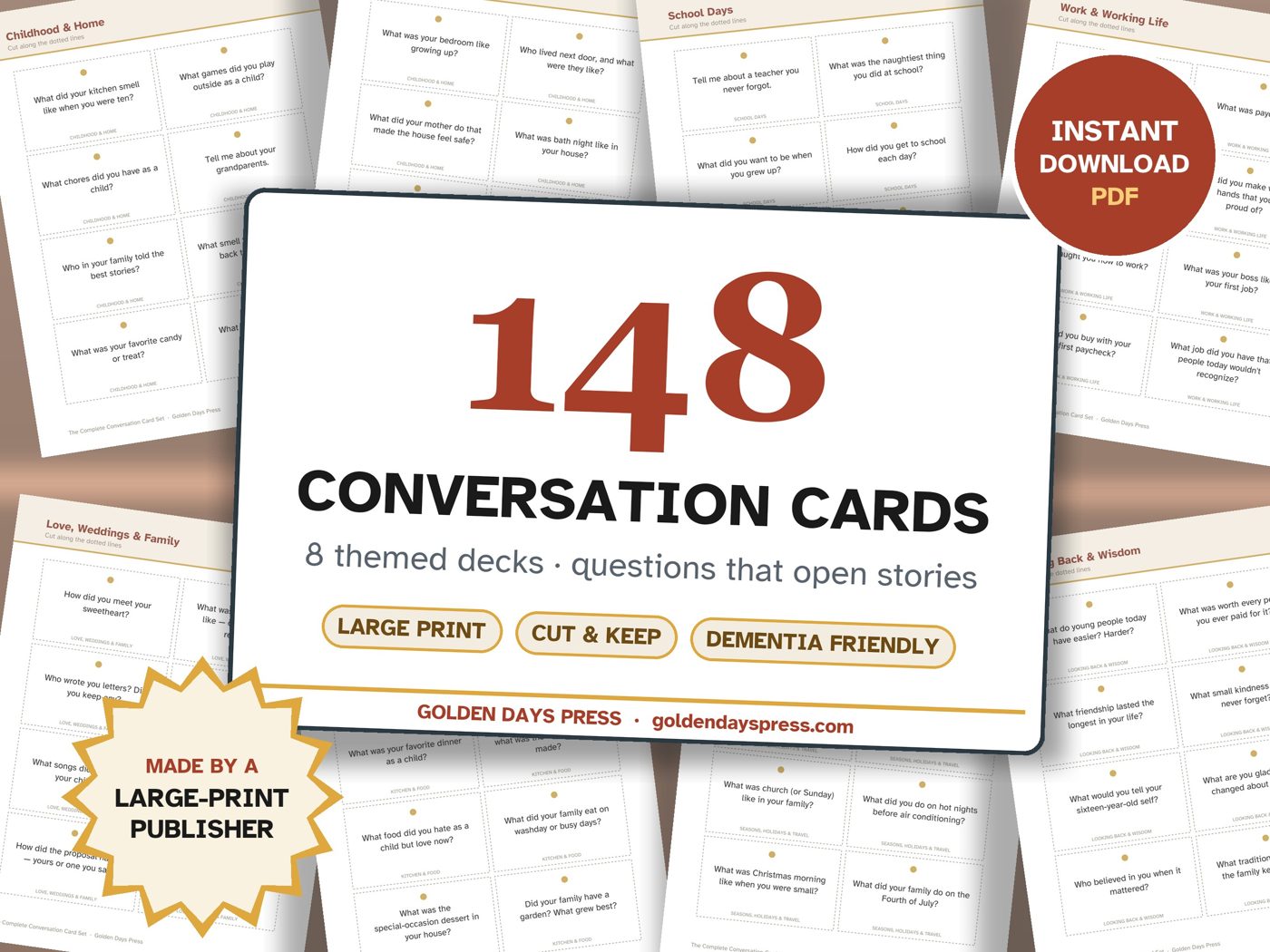
The best conversations with an older parent, a grandmother, or a room full of residents don't test memory. They invite it. These starters ask about firsts, senses, and feelings, which is where the richest memories live, and every one of them is a question you'd be glad to be asked yourself. The 48 in the first list are also a free cut-and-keep card set.
How to use them
- One at a time. Read a question, then stop talking. A story needs room.
- Follow the memory, not the question. If "your first car" turns into the summer of 1958, go to 1958.
- Offer yours first when it stalls. "My first job was bagging groceries for $1.60 an hour. What was yours?"
- Never correct. The year, the name, the town. If it's wrong, it's still hers.
48 conversation starter cards, by theme
Childhood and home
- What did your kitchen smell like when you were ten?
- What did Saturdays look like when you were young?
- Who was your best friend growing up?
- What games did you play outside as a child?
- What chores did you have as a child?
- What smell takes you straight back to childhood?
- What was the naughtiest thing you did at school?
- How did you celebrate birthdays growing up?
- What was your town like when you were young?
- What was your favorite candy or treat?
Work and money
- What was your very first job, and what did it pay?
- What did a dollar buy when you were a teenager?
- What was payday like?
- What tools or machines could you use that others couldn't?
- What was harvest time, or the busy season, like?
- What did you want to be when you grew up?
- What did you make with your own hands that you were proud of?
Love and family
- Who taught you to drive, and how did it go?
- What was your wedding day like, or a wedding you remember?
- How did you meet your sweetheart?
- What was your first home together like?
- What songs did you sing to your children?
- Tell me about your grandparents.
- Who in your family told the best stories?
- Who wrote you letters? Did you keep any?
- What advice from your parents turned out to be true?
Music, fun, and Saturday nights
- What song could always get you dancing?
- What was your favorite dance, and where did you dance it?
- What radio or TV show did your family never miss?
- What was the first movie you saw in a theater?
- What fairs or carnivals did you go to?
- Who was the funniest person you ever knew?
Food, seasons, and weather
- What meal did your mother or father make better than anyone since?
- What did summer taste like when you were young?
- What was the coldest winter you remember?
- What did you do on hot nights before air conditioning?
- Tell me about a snow day, a storm, or a flood you remember.
- Who had the best garden you ever saw?
Places, faith, and pride
- Tell me about your first car.
- What store did you love to visit, and what did you buy?
- Tell me about a teacher you never forgot.
- What was the best trip you ever took?
- What was church, or Sunday, like in your family?
- What pets did your family have?
- What did you wear when you wanted to look your best?
- What neighbor do you still think about?
- What was the best gift you ever received?
- What are you proudest of?
Those are 48 of the 148 prompts in the full deck, sorted into eight themed decks. Conversation Card Deck, $6.99 ↓
Conversation starters for seniors with dementia
When memory is fading, the questions above still work if you change two things. Put something real in the room first (a song playing, a photo on the table, a flower in her hands) and ask about the thing in front of you. Then say "tell me about" instead of "do you remember," because the first is an invitation and the second is a test. Ten starters built that way:
- This song — where does it take you? (Play it first.)
- Smell this. What does it remind you of? (Coffee, cinnamon, a bar of soap.)
- Tell me about this photo. (One photo. Don't ask who is in it.)
- What do you make of this weather?
- Did your mother keep a garden like this? (With the flowers in her hands.)
- What's your favorite thing to eat for breakfast?
- Would you show me how you fold these?
- I love this sweater. Did you like to sew or knit?
- What was a good day like for you?
- Will you tell me about your family?
Whatever comes back is the right answer. A sensory question (smell, song, taste, texture) travels a different road into memory than a date does, and that road stays open longer. More on choosing what fits today is on our activities by ability level page.
For activity rooms: pair a question with an activity
In a group, a conversation starter works best as the doorway to something you do next. Read one card to the circle, let two or three people answer, then move into the activity it points to. The talk gives the activity a reason; the activity gives quiet residents a way to join without speaking.
| Ask | Then do |
|---|---|
| What meal did your mother make better than anyone? | Cook a simple version together; let the smell do the remembering. |
| What song could always get you dancing? | Play three songs from her teenage years and hum along. |
| Who wrote you letters? | Write one together to a grandchild, in her words. |
| What games did you play outside? | Balloon toss or seated ring toss, right there in the room. |
| Who had the best garden you ever saw? | Plant one windowsill pot and give it a job on the sill. |
| What did you wear when you wanted to look your best? | Look through old photos or a catalog, then a manicure. |
| What was your town like when you were young? | Find the old street on a map or an online street view. |
| What did you make with your own hands? | Sort a toolbox or a button tin, or fold a basket of warm towels. |
Thursday is "memory lane" on our free memory care activity calendar; these pairings are what fills that slot.
Questions to ask elderly parents, and write the answers down
Some questions are worth more than an afternoon. These ten are the ones families most often wish they had asked, and they are the ones worth recording, on paper, in the parent's own hand if possible.
- What is the story of your name?
- What do you remember about the house you grew up in?
- How did you and Mom (or Dad) decide to marry?
- What was the hardest year of your life, and what got you through it?
- What did your parents do for work, and what did they teach you about it?
- What do you wish you had asked your own parents?
- Which family recipes matter, and who taught you?
- What did you believe at twenty that you don't believe now?
- Which things in this house have stories behind them?
- What do you want your grandchildren to know about you?
If you'd rather hand over a book than a list, our large-print keepsake journal In My Own Hand asks 110 questions like these, one per page, with room for a parent or grandparent to answer in their own handwriting. It's the gift that comes back to you.
Questions people ask us
What are good conversation starters for seniors?
Questions about firsts, senses, and feelings from their young years: the smell of the kitchen at ten, the first job and what it paid, the song that always got them dancing. Avoid anything with a right answer, such as dates, names, and recent events. A good starter invites a story; a bad one asks for a fact.
How do I start a conversation with an elderly person who doesn't talk much?
Sit at their level, bring something to hold or hear (a photo, a song, a warm cup), and offer one of your own memories first. Then ask a single open question and wait longer than feels comfortable. Silence is often the story getting ready.
What should I avoid asking someone with dementia?
'Do you remember…' in any form, quiz-style questions, 'who am I?', and questions about recent events. Say 'tell me about' instead, accept every answer as the right one, and never correct a detail. The goal is the feeling of the conversation, not its accuracy.
How many questions should I ask in one visit?
One to three. A single question that opens a story beats a dozen answered in a word. If a question stalls, don't repeat it; offer a memory of your own and let the conversation find its footing.
Get the free printable card set
The 48 conversation starters above in large print, formatted to cut and keep, plus blank cards for your own — and our monthly caregiver letter. Unsubscribe anytime.