Free · Activity Guide
Dementia Activities by Ability Level
Families often search for activities "by stage." We sort ours a different way — by what today allows. Stages belong in medical charts; the kitchen table only needs to know one thing: what kind of afternoon is this?
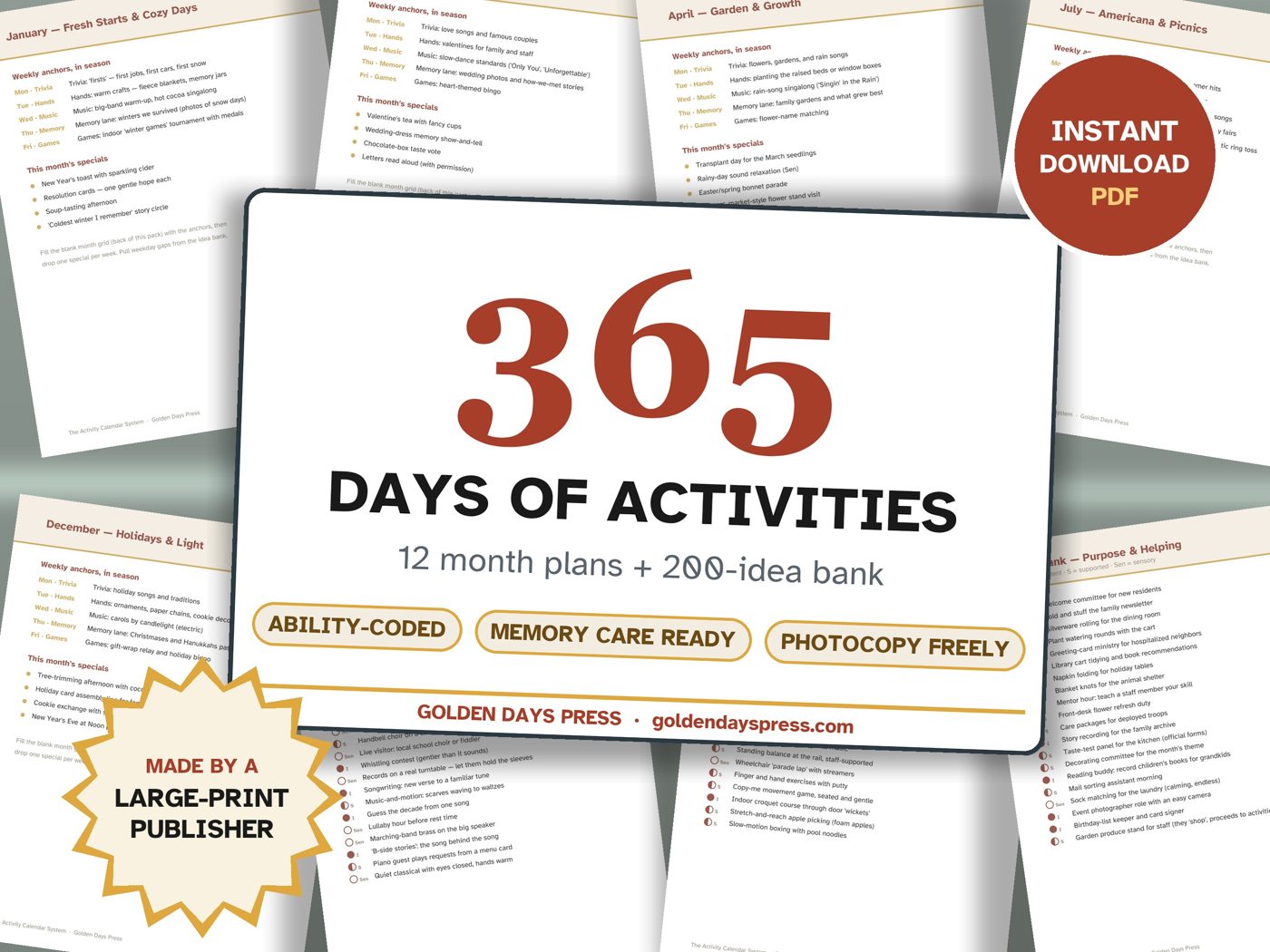
Get the free calendar template
The three levels: Independent, Supported, Sensory
Every activity on this site carries one or more of three codes. They describe how much of the activity your person carries and how much you do — nothing more:
- I — Independent. She runs the activity; you keep her company. The full word search, the whole recipe, the trivia sheet and a pencil.
- S — Supported. You set up each step and do it together, side by side. Same activity, shared load.
- Sen — Sensory. The touching, hearing, smelling, and doing is the whole point. There's no product and no score — only a good hour, which was always the real goal anyway.
The levels aren't a ladder anyone slides down for good. They're a dial you set each day — sometimes twice in one day — and most activities play at more than one level with small changes. That's the skill this page teaches.
How to pick for today
Take sixty seconds before you set the table. Is she starting things on her own this morning — picking up the paper, opening drawers with a plan? Lean Independent. Is she following along comfortably but not initiating? Set up Supported. Is today mostly resting, with words coming slowly? Go Sensory, and let the music and the warm washcloth do the talking. Then watch the first five minutes and adjust without comment. Sliding a level mid-activity isn't failure — it's exactly the system working.
One activity, three ways: the trivia hour
Here's the whole method in a single example, using our free large-print trivia questions:
- Independent: hand over the printed sheet and a pencil, pour two coffees, and let her quiz you. Reading the questions aloud is the hosting role, and it's the best seat in the house.
- Supported: you read each question aloud, offer the first letter as a hint, and treat every answer as a doorway — the question about the drive-in matters less than her story about one.
- Sensory: skip the quiz entirely. Put on a 1962 record, read the questions as conversation prompts in a warm voice, and pass around something from the era — a 45 sleeve, a church cookbook. The trivia becomes atmosphere, and atmosphere is plenty.
Every activity below flexes the same way. Once you've done it with trivia, you'll find yourself doing it with everything.
Fifteen activities, coded
| Activity | I | S | Sen | Making it fit |
|---|---|---|---|---|
| Decade trivia hour | ✓ | ✓ | ✓ | Worked example below — the same questions flex all three ways. |
| Large-print word search | ✓ | ✓ | Supported: across-and-down grids only, or work in pairs. | |
| Singalong to their-era music | ✓ | ✓ | ✓ | Sensory: one song, hands held, no request to sing. |
| Pressed-flower notecards | ✓ | ✓ | Supported: you glue, she arranges. The cards still get mailed. | |
| Watercolor painting | ✓ | ✓ | ✓ | No wrong way to watercolor; the brush in water is the sensory version. |
| Balloon volleyball | ✓ | ✓ | Seated circle, one balloon. See our balance activities page. | |
| Folding warm laundry | ✓ | Real work, warm from the dryer, impossible to fail. | ||
| Sorting buttons by color | ✓ | ✓ | Large buttons only, together at the table. | |
| Hand massage with lotion | ✓ | Unscented or their old favorite. Company is the activity. | ||
| Watering the plants | ✓ | ✓ | A small can and a route around the house makes it a job, not a chore. | |
| Photo album visit | ✓ | ✓ | ✓ | Sensory: one photo, your voice naming people gently, no questions. |
| Baking a familiar recipe | ✓ | She measures and stirs; you handle the oven. The smell does the reminiscing. | ||
| Conversation cards | ✓ | ✓ | Open prompts, one at a time. "Tell me about," never "do you remember." | |
| Sensory bin | ✓ | Fabric scraps, smooth wood, seashells — adult objects worth touching, nothing small enough to swallow. | ||
| Reading aloud | ✓ | ✓ | Poems, psalms, old letters. Familiar words land even when new ones don't. |
Full write-ups for many of these live on their own pages: crafts with materials lists, balance and movement games, word searches done right, and the whole free printable library.
Questions families ask
Isn't this just dementia stages with different names?
No, and the difference matters at the table. Stages describe an illness over years and belong in conversations with doctors. Ability levels describe a person this afternoon — and this afternoon is the only thing an activity has to fit.
What if I pick the wrong level?
You'll know in five minutes, and nothing is lost. Slide down a level without announcing it — hand over the pre-cut pieces, offer the first letter, put the song on. Moving down isn't defeat; it's hosting.
Can two levels be true on the same day?
Most days, yes. Plenty of people run a trivia hour independently at ten and want a supported, slower version at four. Energy moves through a day; let the activity move with it.
Get the free calendar template
A printable monthly activity calendar for planning the week by ability level — plus one gentle, useful email a month. Unsubscribe anytime.