Free · Family Guide
Reminiscence Therapy: A Practical Family Guide
The fancy name for the best hour you'll spend with your mother this week. Here's what it is, why it works when so much else has stopped working, and how to do it at home tonight with a photo album and a record.
What is reminiscence therapy?
Reminiscence therapy is the guided use of prompts — photographs, music, familiar objects, and open questions — to help a person recall and share memories from their own life. It matters for people with memory loss because the long-ago years often stay reachable when last Tuesday doesn't: leading with those years lets someone be the expert in the room again. Memory care communities run it as group sessions; families do it at the kitchen table with a shoebox of photos. Same thing, different furniture.
One honest framing note. Reminiscence is an approach that families and activity staff use every day — it is not a medical treatment, and nothing here is medical advice. What we can tell you from the activity-room side is that it reliably produces good hours, and good hours are the whole business.
The reminiscence bump: why the '50s and '60s stay bright
Memory researchers have a name for something families notice on their own: the reminiscence bump. People recall the years from roughly age ten to thirty more vividly than any other stretch of life — first dance, first job, first car, the songs on the radio the summer they were nineteen. Those memories were laid down deep, rehearsed for decades, and they tend to stay standing longest.
This is why a question about 1962 lands when a question about this morning falls flat. You're not avoiding the present; you're meeting the person where their strongest self lives. For today's seniors, aim at the 1950s, '60s, and '70s — and pick the decade of their teens and twenties, not yours.
How to do it at home, tonight
- Pick one thing. One photo, one song, or one object — not a stack. A single wedding photo beats the whole album, because there's nowhere to hurry to.
- Sit beside, not across. Side by side, both facing the photo. It feels like company, not an interview.
- Open with "tell me about," never "do you remember." "Tell me about this kitchen" has no wrong answer. "Do you remember this kitchen?" is a test, and tests make people go quiet.
- Follow the story wherever it goes. If the wedding photo leads to a story about the getaway car, go with the car. The plan was always to end up in a story.
- Let silence work. Old memories surface slowly. Count to ten in your head before offering another prompt; most of the best material arrives in the pause.
- End warm. Fifteen good minutes is a triumph. Close with the song still playing, not after the well runs dry.
Photos, music, objects: the three doorways
Photos. Work from photocopies rather than originals, so nothing precious can tear and shaky hands can hold freely. Name people casually as you point — "your brother Earl had some car" — so recall is never on trial.
Music. The fastest doorway there is. Play one song from their high-school years — one, not a shuffled playlist — and watch the foot start tapping before the first chorus. Songs carry the words with them; people who speak little often still sing whole verses.
Objects and senses. A rolling pin, a hand plane, a percolator going in the kitchen, a bar of the soap her mother bought. Hands and noses remember on their own schedule. Put the object in their hands and ask what it's for — being the one who knows is a fine feeling.
What to avoid
- Quizzing. "Who am I?" and "What year was this?" turn a visit into an exam. Give the answer away for free — "It's Susan, Mom" — and spend the hour on stories instead.
- Correcting the record. If the story says the car was blue and you know it was green, it was blue today. The feeling is the fact that matters.
- Forcing chronology. Memories don't file in order. Jumping from 1958 to 1974 and back is fine; you're visiting, not archiving.
- Treating tears as failure. Some good memories are bittersweet, and feeling them is part of a full visit. Stay close, keep your voice gentle, and change the doorway — a different song, the kettle on — if sadness settles in rather than passes through.
Making it a habit
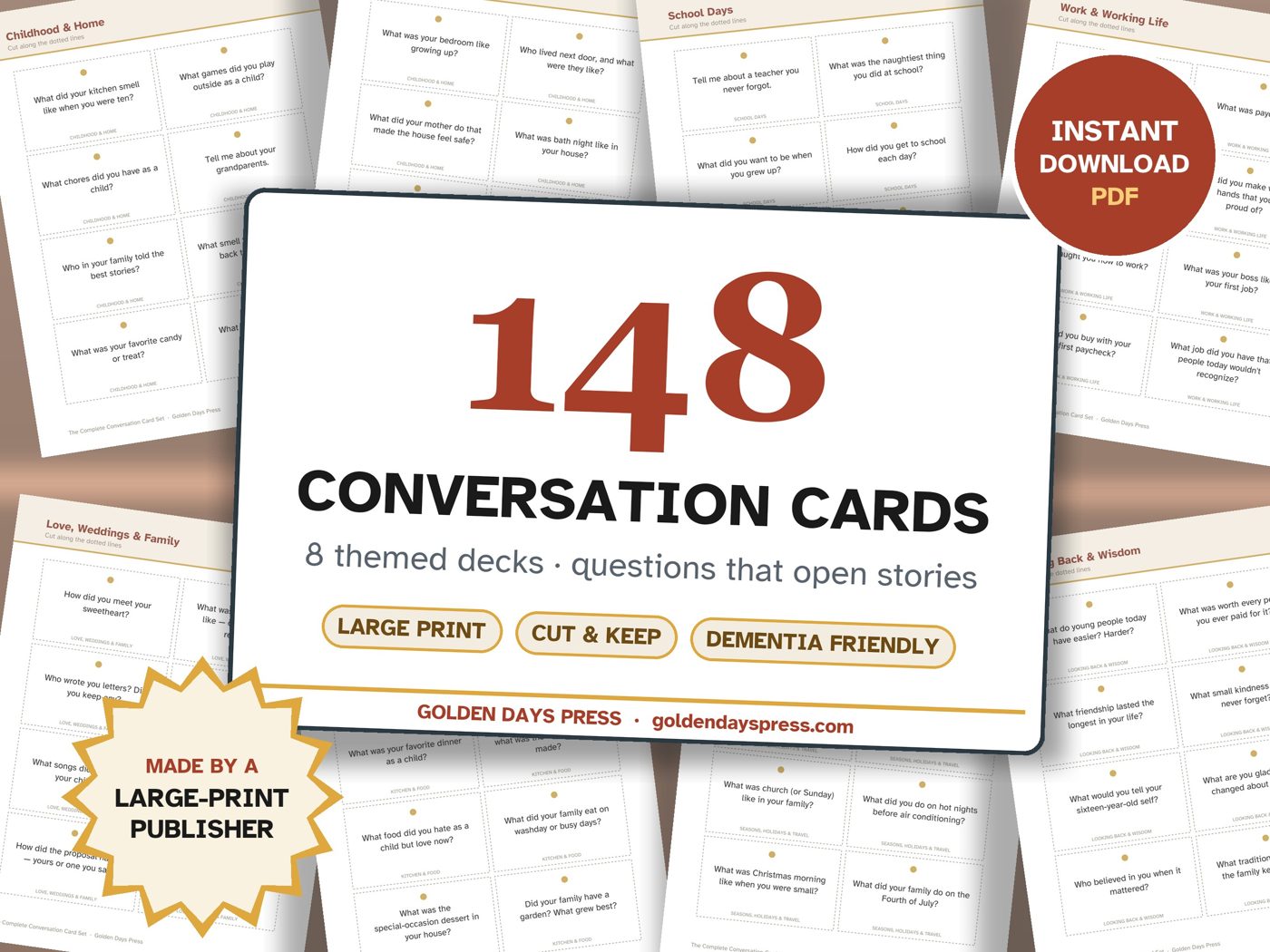
The families who get the most from reminiscing keep the materials where the visit happens: an album on the coffee table, a box of objects by the good chair, prompts in the kitchen drawer. Our free conversation starters make ready-made doorways, the large-print trivia questions turn reminiscing into a game night, and our 1960s trivia page aims straight at the bump years. Busy hands help too — see our crafts guide for projects that loosen stories while the glue dries.
Questions families ask
Is reminiscence therapy different from just looking at old photos together?
Mostly in intent. The photo hour becomes reminiscence when you slow down, ask open questions, and follow wherever the memory goes instead of turning pages. Same album, better afternoon — no training required.
What memories work best?
The teens and twenties, almost always. Researchers call it the reminiscence bump: those years stay vivid long after last week goes soft. For today's seniors that means the 1950s through the 1970s — first jobs, first cars, the kitchen they grew up in.
What if the same story comes up every visit?
Let it. A favorite story is a favorite for a reason, and telling it well feels good every single time. Hear it fresh, ask one new question about it, and it often opens a door you haven't been through.
Can we still do this when conversation is mostly gone?
Yes — the senses carry it. Play the song, put the rolling pin in her hands, let the coffee percolate where she can smell it. A memory doesn't need words to be felt, and being together in it is the whole point.
Get free conversation prompts
A printable set of reminiscence-ready conversation starters in large print — plus one gentle, useful email a month. Unsubscribe anytime.