Free · PDF
Large-Print Coloring Pages for Seniors
Coloring is one of the few activities that asks nothing of memory. There is no rule to recall, no score, no right answer, and the result is something to keep, show, or give away. These pages are drawn for adult eyes and adult hands: outlines thick enough to see across a table, regions big enough for a chunky marker, and subjects with a story attached. Six are free below; the full pack has thirty-six.
Download the 6 free coloring pages
Six pages here for free; the full pack is 36 designs in six seasonal sets. Large-Print Coloring Pack, $3.99 ↓
Why coloring works in memory care
A hand that has held a pencil for eighty years knows what to do with one. That is the whole secret. Coloring uses skills laid down in childhood and never lost: grip, pressure, staying near a line, choosing a color. It gives a restless afternoon a shape, it is quiet company for someone who does not want to talk, and it produces a thing. The thing matters. A finished page on the door of a room is proof of a good hour, to the person who colored it and to the daughter who visits on Sunday.
It also travels. The same page works at a kitchen table, on a wheelchair tray, at a group table with eight people and one tray of markers, or in a bed with a clipboard. Nothing else in the activity cupboard is that flexible.
What "large print" means for a coloring page
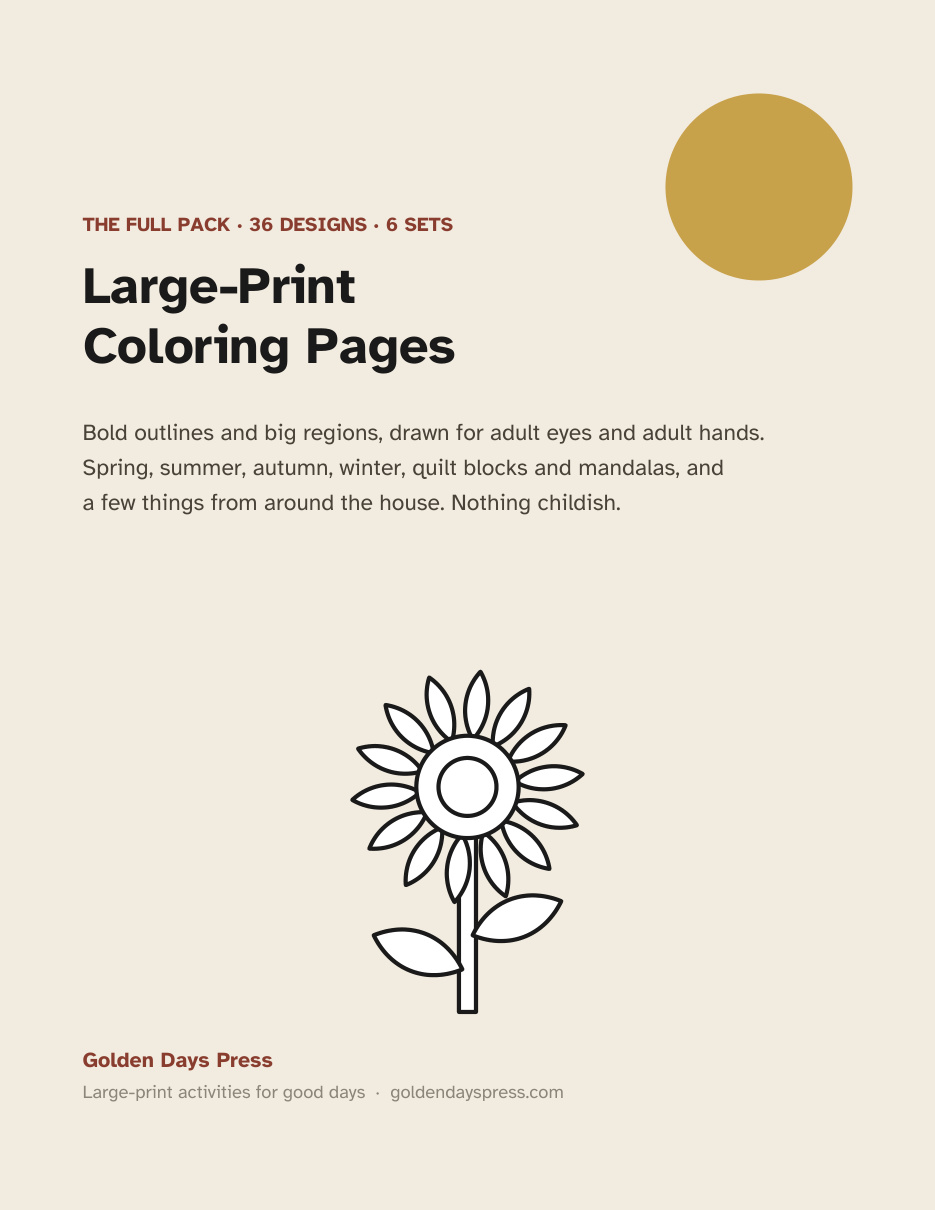
Most adult coloring books are the opposite of what an older hand needs: hairline outlines and hundreds of regions the size of a lentil. Ours are drawn to three rules. The outline is 2.75 points, about three times the weight of a typical coloring book, so it reads from arm's length and survives a marker crossing it. The smallest fillable region is roughly the size of a quarter, and most are far larger; a page has somewhere between ten and thirty-five regions, never hundreds. And the drawing fills a six-and-a-half-inch square of a letter page, with one quiet title underneath and nothing else. No words inside the art, no cartoon faces, no clutter.
That is also why these are drawn as clean line art rather than photographs turned into outlines. A teacup drawn with nine regions can be colored in ten minutes with a marker. The same teacup traced from a photo has ninety, and gets abandoned.
Choosing the tools
Chunky washable markers are the easiest thing to hold and give the boldest result. Triangular colored pencils are next: the three flat sides stop the pencil rolling and sit naturally in a loose grip. Skip gel pens, fine-tip markers, and anything scented; scent in a closed room is a headache for half the table. Print on plain letter paper, or card stock if the markers bleed. Keep a pencil sharpener on the table and nothing else that needs managing.
Setting up the table
- Put out six colors, not thirty. Choosing from a small tray is a pleasure; choosing from a big box is a job. Rotate the tray between sessions so the choice stays fresh.
- Square the page and light it from the side. A clipboard stops the sheet sliding, and side light keeps the hand's shadow off the work. Overhead light alone flattens the outlines.
- One page at a time. A stack invites hurry. A single page on the table says this is the afternoon's work, and it is.
- Sit beside, not across. You can guide a hand, point to a region, or just color the other half of the same page. Coloring together is quieter company than conversation, and often opens more of it.
- Finish with a display. A clip on the door, a spot on the fridge, a walk to the nurses' station to show it off. The page is done when someone else has seen it.
Adapting the page to the person
For tremor or arthritis
Fat markers or triangular pencils; a foam pencil grip, or a strip of pipe insulation slit and slipped over a marker, turns any tool into a fat one. Tape the corners of the page down. Nobody needs to stay inside the lines; if it bothers them, lay a sheet of paper over the finished half.
For low vision
Start with the boldest designs: the snowflake, the quilt blocks, the mandalas. Dark colors on a white page read better than pastels. Say the name of the region out loud before they fill it: the roof, the sail, the big petal at the top.
For later-stage memory loss
One page, two colors, and your hand beside theirs. The act of coloring is the activity; a finished page is not the goal. Simple objects with a story attached, the teacup or the rotary telephone, tend to hold attention longer than patterns.
For a group
Give everyone the same design so the table can compare, then hang all of them together. A theme day is built in: the whole Autumn Harvest set on the first cold morning, the Holidays set for the week the tree goes up.
Coloring through the year
The designs are grouped by season so the page on the table matches the world outside the window, which is its own reminiscence prompt. Tulips and a watering can when the garden wakes up; a sailboat and a sundae in July; the pumpkin on the fence the first cold morning; the cardinal and the snowflake when the feeder is busy. The quilt blocks and mandalas are for any day, and they are the boldest pages in the set, so they are also the right place to start with low vision. The household set, a teacup, a vintage radio, a rotary telephone, a record player, is where the stories come from: a rotary phone is a party line, a first phone call, a number someone can still recite.
The designs
Thirty-six designs in six sets. The six marked with a star are the free sampler at the bottom of this page, one from each set.
Spring Garden
- Tulips in a Row ★
- Watering Can with Flowers
- Easter Basket
- Umbrella and Raindrops
- Birdhouse
- Butterfly
- Garden Gate
- Kite
Summer Days
- Sunflower ★
- Sailboat
- Lighthouse
- Beach Umbrella
- Hot-Air Balloon
- Ice-Cream Sundae
- Flag and Stars
- Rooster
Autumn Harvest
- Autumn Leaves
- Pumpkin on a Fence ★
- Apple Basket
- Slice of Pie
- Acorn and Oak Leaf
Winter Comforts
- Snowflake ★
- Holly and Berries
- Mittens and Scarf
- Cardinal on a Branch
- Snowman
Quilt Blocks and Mandalas
- Log Cabin Block ★
- Shoo Fly Block
- Sawtooth Star Block
- Pinwheel Block
- Eight-Petal Mandala
- Twelve-Petal Mandala
Around the House
- Teacup and Saucer ★
- Vintage Radio
- Rotary Telephone
- Record Player
Coloring sits beside two other pages here: the fifteen no-fail crafts for the days when hands want to make something, and activities by ability level for choosing between them on a given afternoon.
Questions families and activity directors ask
What makes a coloring page 'large print'?
Line weight and region size. Ours use a 2.75-point outline, about three times the weight of a typical coloring book, and the smallest region on a page is roughly the size of a quarter. Most regions are much bigger. Each design fills a six-and-a-half-inch square on a letter page.
Are these childish?
No. The subjects are adult: quilt blocks, a lighthouse, a rotary telephone, a slice of pie. There are no cartoon faces and no words inside the art. A quiet title sits under each drawing, nothing else.
Which tools work best?
Chunky washable markers or triangular colored pencils, unscented. Skip gel pens and fine-tip anything. Print on plain letter paper; card stock if markers bleed through.
Is coloring appropriate for people with dementia?
Yes, and it asks nothing of memory. There is no rule to recall and no right answer, and a hand that has held a pencil for eighty years knows what to do with one. Adapt the tools and the pace, and keep the page in front of the person, not in a stack.
Can I use these in a care community?
Yes. The licence covers personal use and single-location activity-program use, one home or one facility, with unlimited printing at that location. Please don't resell or redistribute the files.
Coloring pairs naturally with the conversation cards on the same table and the bingo hour that follows it. Everything free on this site lives in the printable library.
Get the 6 free large-print coloring pages
Sunflower, tulips, the pumpkin on the fence, a snowflake, a log cabin quilt block, and a teacup — plus the one-page guide to coloring with seniors, and one gentle, useful email a month. Unsubscribe anytime.